
“How long will it last?” is usually the second question people ask about a coated garage floor, right after price. The honest answer is that it depends on what was installed and how the slab was prepared. A thin water-based kit and a professionally installed multi-coat system are very different products, even if they both get called “epoxy.” Here is what typical lifespans look like, what shortens them in the Evansville area, and how to get the most years out of your floor.
How long does garage floor epoxy last?
Typical lifespans by system:
| Coating | Typical lifespan |
|---|---|
| Water-based DIY epoxy | 3–5 years |
| Professional solid epoxy | 10–20 years |
| Polyaspartic | 10–20+ years |
The wide ranges are real. Two floors with the same coating can land at opposite ends depending on prep, traffic, chemicals and how they are cared for. A garage that holds one commuter car is a different environment from a shop floor that sees jacks, rolling toolboxes and dropped parts every day.
Why some floors fail in a year or two
Early failure almost always traces back to one of a few causes:
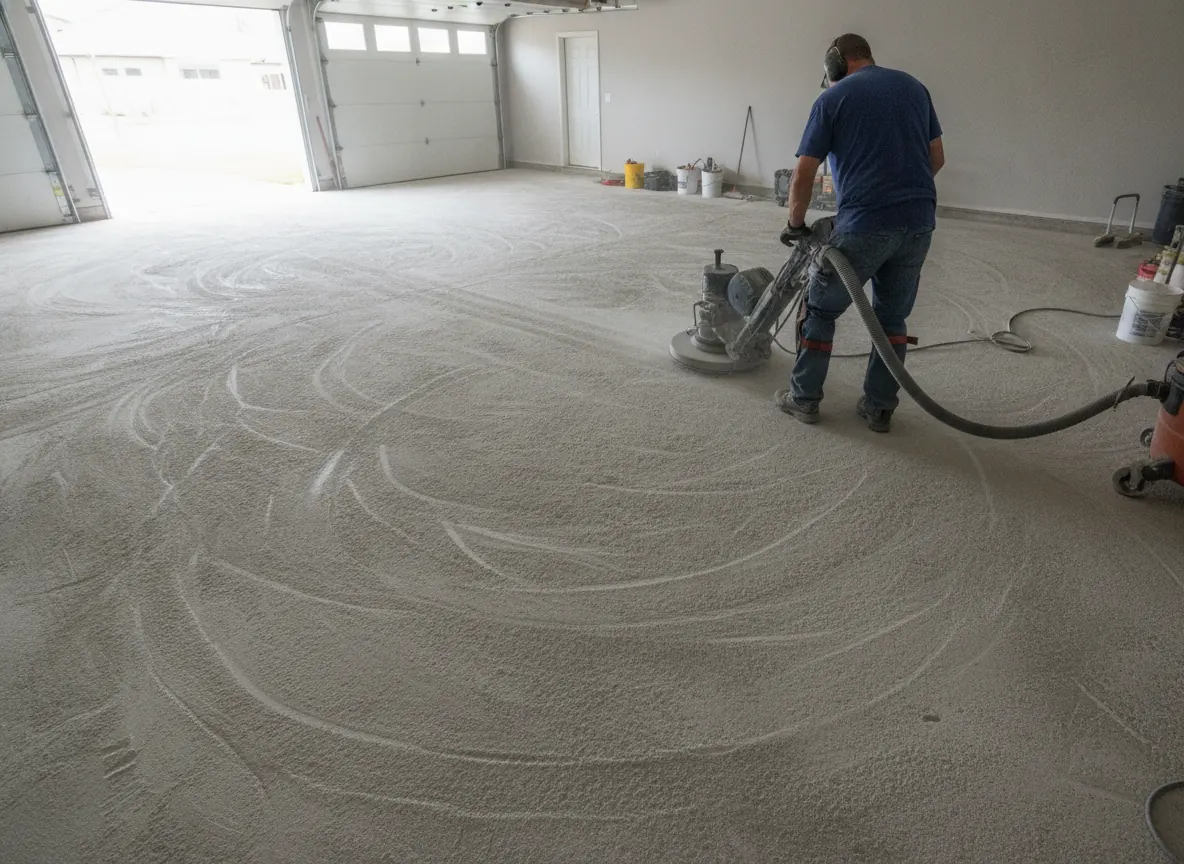
- Poor surface prep. Coating needs an open, clean concrete profile to grip. Rolling over a smooth, dusty or previously sealed slab is the most common reason coatings peel. Diamond grinding is the method most installers rely on; you can read why in do you have to grind before epoxy.
- Moisture in the slab. Water vapor coming up through the concrete can push a coating off from below. A moisture barrier, typically about +$1/sq ft, is sometimes recommended for this.
- Too thin a film. Water-based kits go on thin, which is a big reason their typical lifespan is 3–5 years.
- Driving on it too soon. A coating that is not fully cured can mark or lift under tires, especially hot ones. See our post on hot tire pickup.
- Unrepaired cracks and spalls. Damage left under the coating keeps moving and can telegraph through.
What shortens a floor’s life in the Tri-State
Local conditions add their own wear. Indiana pavements see “a large number of freezing and thawing cycles each year,” according to INDOT, and the counties around Evansville spread a lot of salt to keep roads open. The Vanderburgh County Highway Department typically uses 7,000–11,000 tons a winter, and the city had 6,000 tons ready for the January 2026 storm. That brine rides into your garage on tires and wheel wells and sits on the floor as it melts.
Summers bring their own test. Evansville averages about 41 days a year at or above 90°F, and July’s mean high is 88.6°F. Tires coming off hot pavement are softer and stickier, and they sit on the same spots every day. Sunlight through an open door can also yellow standard epoxy that lacks a UV-stable top coat.
Housing age matters too. The median Evansville home was built in 1961, and many garage slabs in older neighborhoods have decades of oil stains, old paint or sealers, and cracks. Those floors can still be coated well, but they need more prep, and skipping that prep is how a 10-year floor becomes a two-year floor.
Signs your coating is wearing out
- Dull, scuffed lanes where the tires roll and park
- Peeling or lifting edges, often near the door or around cracks
- Yellowing near the door opening
- White haze or blistering that may point to moisture under the coating
- Chips that expose gray concrete underneath
A worn but well-bonded floor can often be refreshed with a new top coat after scuffing. A floor that is peeling over a large area usually needs to be ground off and redone.
How to make your garage floor coating last longer
- Pay for prep. Ask how the slab will be prepared, how cracks will be filled and whether moisture will be checked.
- Choose the right top coat. A UV-stable polyaspartic top coat helps in sunny garages. Compare options in epoxy vs polyaspartic.
- Respect the cure. Follow the installer’s timeline for foot traffic and parking.
- Rinse salt off in winter. A squeegee and a periodic rinse keep brine from sitting for weeks.
- Use mats where it makes sense. A mat under jack stands or a workbench reduces point damage.
- Clean up spills. Oil, antifreeze and battery acid should not sit on any floor.
Is it worth paying more for a longer-lasting floor?
Spread across its life, a professional floor can compare well with repeated DIY kits. Typical installed ranges for a 2-car garage (about 500 sq ft) are $2,500–$4,000 for solid-color epoxy and $3,000–$6,000 for a polyaspartic flake system, according to our 2025–2026 estimates. DIY kits run about $50–$600 in materials. If a kit lasts 3–5 years and a pro floor lasts 10–20, the cost per year can narrow, though only you can weigh that against your budget and plans for the house. We compare the two honestly in DIY epoxy kit vs professional, and full numbers live on the cost page.
What about warranties?
Installers in this industry often offer written warranties, and terms vary widely. Some cover only peeling or delamination, some exclude hot-tire marks or moisture problems, and phrases like “limited lifetime” usually come with conditions. We don’t make warranty promises ourselves; instead, ask any installer for the written terms and read what is excluded before you sign.
Want to know what a long-lasting floor would cost in your garage? Get a free quote and we’ll connect you with a local installer who can check your slab in person.
Quick answers
Can you re-coat an old epoxy garage floor?
Often, yes. If the existing coating is still well bonded and only worn on top, an installer can usually scuff or lightly grind it and apply a fresh top coat. If it is peeling, blistering or lifting over large areas, the old coating generally has to be ground off so the new system can bond to clean concrete.
Does a flake floor last longer than solid epoxy?
A flake broadcast adds texture and hides wear and dirt, and flake systems are usually finished with a clear top coat that takes the abrasion. That can help a floor look good longer. Real lifespan still depends most on surface prep, film thickness and the top coat chemistry, so ask how the whole system is built.