
You pull in on a July afternoon, park, and a few days later you notice the coating under your tires has turned cloudy, lifted, or peeled off in the shape of a tread. That is hot tire pickup, and it is one of the most common complaints about coated garage floors. The good news is that it is usually preventable. This guide explains why epoxy garage floors and hot tires sometimes don’t get along, and what installers do about it.
What is hot tire pickup?
Hot tire pickup is when a garage floor coating sticks to warm tires and gets pulled away from the concrete, or gets marked and softened where the tires sit. It usually appears in the exact spots where you park every day. Sometimes the coating lifts in patches; sometimes it stains or leaves tire-shaped marks that will not scrub out.
Why does it happen?
Tires heat up on the road and soften. When they come to rest on the floor, they press down on the coating and cling to it. As the tires cool, they contract slightly and can tug at whatever they have gripped. If the coating is bonded strongly to the concrete, nothing happens. If it is weakly bonded, too thin, or not fully cured, the tire can win that tug of war.
That is why the root causes are almost always the same few things:
- Weak bond to the concrete, usually from poor prep: a slab that was only cleaned, or acid-etched unevenly, instead of mechanically ground.
- A thin film, common with water-based DIY epoxy and one-coat products.
- Parking too soon, before the coating has fully cured.
- Old sealers, paint or oil left on the slab under the new coating.
Why Evansville summers make it worse
Hot tire pickup is a heat problem, and Evansville has heat. The NWS Paducah normals put July’s mean high at 88.6°F with a mean low of 68.8°F, and the area averages about 41 days a year at or above 90°F. Asphalt gets far hotter than the air on those days, so tires roll into the garage warm.
Humidity can play a part on install day, too. The muggy period runs roughly May 10 to October 13, July averages 29.3 muggy days, and the NWS reported dewpoints in the mid-70s to low-80s in late July 2025. Moisture and heat both affect how coatings flow and cure, which is why careful installers check conditions before they mix a batch and follow the product directions closely.
How prep prevents hot tire pickup
The single biggest defense is surface preparation. Most professional crews diamond-grind the slab to open up the concrete and give the coating something to grip, then vacuum the dust, repair cracks and spalls, and degrease oil spots. Grinding also removes old sealers or paint that would otherwise sit between the new coating and the concrete.
Many Evansville-area garages are on older slabs (the median Evansville home was built in 1961), and decades of oil drips and old products are common. Those floors can be coated successfully, but they need the full prep. For more on why grinding matters, see do you have to grind before epoxy and our concrete prep and crack repair page.
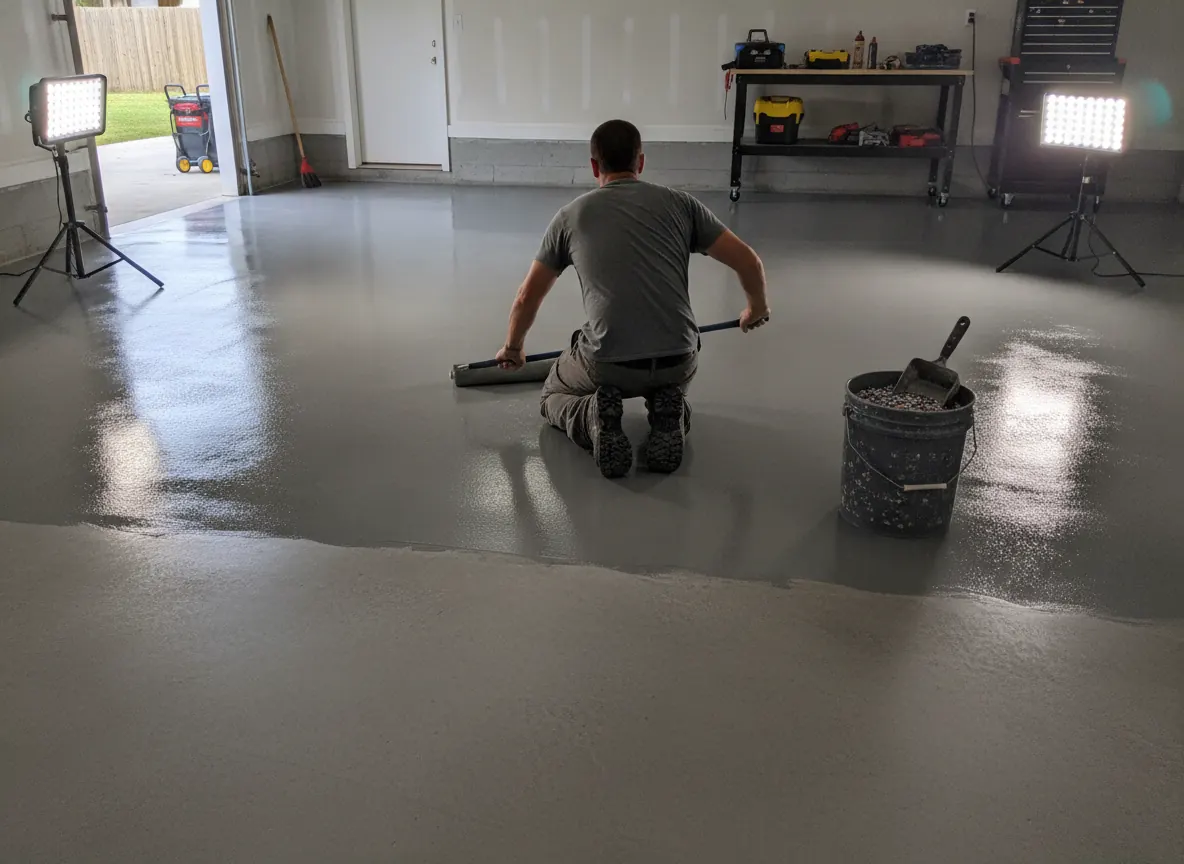
Primers and top coats that resist hot tires
Beyond prep, the system itself matters:
- A penetrating primer or base coat that soaks into freshly ground concrete improves the bond the rest of the system depends on.
- Enough total thickness. Multi-coat systems with a flake broadcast build far more film than a single thin coat.
- A hard, chemical-resistant top coat. Polyaspartic top coats are popular partly because they are generally considered more resistant to abrasion, chemicals and UV than standard epoxy. Compare them in epoxy vs polyaspartic.
Ask any installer what goes into each layer and why. A clear answer is a good sign. You can see how these systems come together on our flake garage floor coating page.
How long to wait before parking
Even a well-built floor can be marked if you park on it before it has cured. Epoxy generally needs longer than polyaspartic, and cooler or more humid conditions can slow curing further. There is no single number that fits every product, so go by the manufacturer’s directions and your installer’s instructions, and when in doubt, give it extra time. Our cure time guide covers what “dry” and “cured” really mean.
Is it a DIY kit problem?
Hot tire pickup is most often reported with thin, water-based kits. They are applied over lightly cleaned or etched concrete, they build very little film, and homeowners often park on them as soon as they look dry. That doesn’t mean every kit fails, but it is the most common setup for this problem. We look at the trade-offs in DIY epoxy kit vs professional.
What if your floor already has hot tire marks?
If the coating has lifted, the area under it was likely weakly bonded. Patching the spot sometimes works, but if the problem is poor prep, more spots usually follow. Many homeowners end up having the old coating ground off and a full system installed. Expect to need crack/chip patching ($25–$250) or, for a badly damaged slab, resurfacing ($3–$5/sq ft) on top of the coating itself; see the cost page for typical ranges.
Tired of peeling tire marks? Request a free quote and we’ll connect you with a local installer who can look at your floor and explain what it would take to fix it properly.
Quick answers
How do you protect an epoxy floor from hot tires?
Start with good prep: a diamond-ground, clean slab with repaired cracks. Use a system with a penetrating primer or base coat, enough total thickness, and a hard top coat such as polyaspartic. Then wait the full cure time before parking. Parking mats can help in daily tire spots, but they are not a substitute for a well-bonded coating.
Do polyaspartic floors get hot tire pickup?
Any coating can lift if it is poorly bonded or not fully cured. Polyaspartic top coats are generally considered harder and more resistant than standard epoxy, which helps, but the bond to the concrete underneath still depends on prep. Ask installers how they prepare the slab and how long you should wait before parking.