
Flake Garage Floor Coating in Evansville
A broadcast flake floor is the workhorse finish for Tri-State garages: textured, forgiving of dirt, and built in layers so it can take winter traffic and summer heat.
Get a Free QuoteThe problem: bare concrete and plain paint don't last in a working garage
Most garage slabs in the Evansville area are doing a hard job with no protection at all. The median home in Evansville was built in 1961, so plenty of floors have had six decades of oil drips, tracked-in grit and winter slush soaking into the surface. Bare concrete is porous. It drinks up stains, dusts as it wears, and it takes on whatever melts off the car.
Winter is the heavy part. The City of Evansville staged 6,000 tons of salt and 12 routes for the January 2026 storm, and the Vanderburgh County Highway Department typically uses 7,000 to 11,000 tons of salt in a winter. A lot of that brine rides home in your wheel wells and drips onto the slab. A thin coat of garage-floor paint or a one-coat kit usually can't hold up. It peels where tires sit, and the salt water keeps reaching the concrete.
The solution: a multi-layer flake system
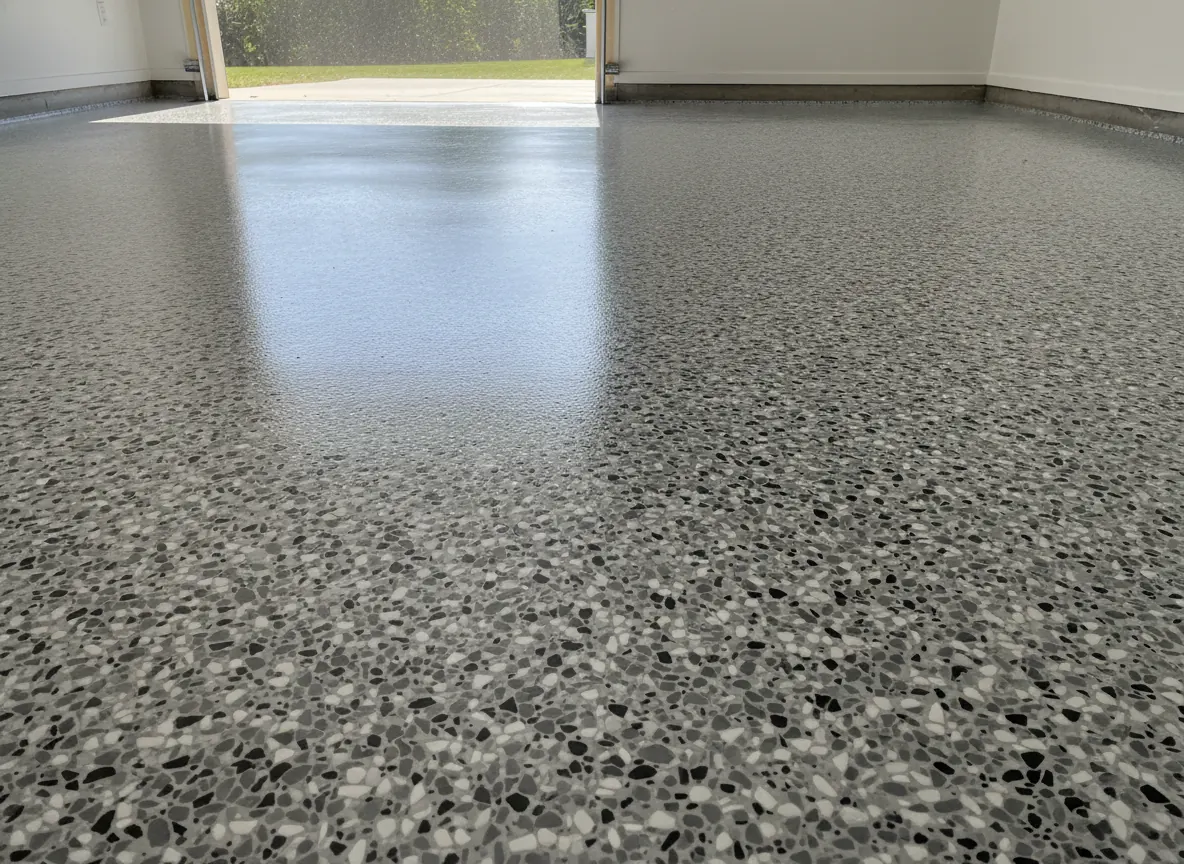
A flake (also called chip or broadcast) floor is built in layers. A base coat goes on a ground, repaired slab. While it is still wet, vinyl flakes are broadcast across it, often to full coverage. After it cures, the loose flakes are scraped off and one or two clear topcoats lock everything in.
- Hides dust, tire marks and small slab flaws far better than a solid color
- The flake texture adds grip underfoot, and an anti-slip additive can be mixed into the topcoat
- Thicker than a roll-on kit, so it has more to give before wear reaches the concrete
- Comes in dozens of color blends, from gray granite looks to tan and black mixes that match brick homes
Flake systems can be built on an epoxy base with an epoxy or polyaspartic topcoat, or entirely in polyaspartic. The base chemistry changes the cure time and the price, but the look and feel are similar. If you are still deciding, our guide to flake vs metallic vs solid color floors covers how each one looks after a few years of use, and polyaspartic flake coating explains the fast-cure option.
How a flake floor gets installed
Every job starts with an on-site look at your slab. Here is the usual sequence. Our process page walks through each step in more detail.
Inspect and moisture-check
The installer looks for cracks, spalling, old coatings and signs of moisture, then measures the floor so the quote is based on real square footage.
Diamond grind
The surface is ground to open the pores and remove weak concrete and old sealers. This is the step that lets the base coat bite. See concrete prep and crack repair.
Repair cracks and pits
Cracks, chips and control joints are filled and ground flush, so they don't telegraph through the finished floor.
Base coat and flake broadcast
A pigmented base coat is rolled out and flakes are thrown by hand until the surface is covered evenly.
Scrape and topcoat
After curing, loose and standing flakes are scraped and vacuumed, then the clear topcoat is applied. Many homeowners add anti-slip grit here.
Cure and return the garage
Foot traffic usually comes first and vehicles later. Exact times depend on the products and the weather, so follow your installer's directions and keep the space ventilated.
What a flake floor typically costs in Evansville
Typical installed ranges, 2025–2026 (estimates only): a flake epoxy system runs about $5.50–$10 per sq ft, roughly $1,400–$2,500 for a 1-car garage (~250 sq ft), $2,750–$5,000 for a 2-car (~500 sq ft) and $4,100–$7,500 for a 3-car (~750 sq ft). A polyaspartic flake system runs about $6–$12 per sq ft. Crack and chip patching typically adds $25–$250.
Your real number depends on slab condition, size, flake blend and topcoat choice. The full breakdown by garage size and system is on our garage floor epoxy cost guide, and an exact price comes from a free on-site quote.
A note on warranties: many installers in this industry offer a written warranty, and terms vary a lot. Ask any installer for the warranty in writing, including what it excludes (hot-tire lift, moisture, chemical damage) before you sign.
Flake Coating FAQ
Is a flake floor slippery when wet?
The flake texture gives more grip than a smooth solid color, but any glossy coating can get slick with water, salt slush or oil on it. Most installers can mix an anti-slip aggregate into the topcoat for extra traction. Ask for a sample board so you can feel the texture before you choose. Our article on whether epoxy garage floors are slippery covers it in more depth.
How long does a flake garage floor last?
Lifespan depends on prep, product and use. As typical industry figures, professionally installed solid epoxy lasts about 10 to 20 years and polyaspartic about 10 to 20 years or more, while water-based DIY epoxy usually lasts 3 to 5 years. A properly ground slab and a quality topcoat matter more than the flake itself.
Will a flake coating hide the stains and cracks in my old floor?
Flakes are very good at disguising small blemishes, color variation and patched areas. Deep oil stains, though, should be cleaned and ground out first so the coating bonds, and cracks need to be filled before coating. A flake floor hides cosmetic flaws well, but it does not fix structural problems in the slab.
Can I choose my flake colors?
Yes. Flake blends come in many color mixes and chip sizes, from light grays to darker tan, brown and black combinations. Darker, busier blends hide dirt best, while lighter blends brighten a garage. Ask the installer to bring physical samples to the estimate so you can see them in your own garage lighting.
How soon can I park on a new flake floor?
It depends on the system and the temperature. Epoxy-based flake floors usually need several days before vehicle traffic, while polyaspartic systems can often be ready sooner. Cooler weather slows curing. Your installer should give you written return-to-service times, and you should follow them along with the product directions.
Ready for a garage floor that cleans up in minutes?
Free, no-pressure quotes across Evansville, Newburgh, Henderson and the Tri-State.