
Can You Epoxy a New Garage Floor? A Guide for Newburgh and Evansville
Can you epoxy a new garage floor? Yes, but not right away. Fresh concrete holds water that has to leave the slab, and a coating rolled over concrete that is still drying can lose its grip. The safe order is cure, test, grind, then coat. How long to wait comes from the coating maker’s directions and a moisture check on your own slab, not from one number everyone repeats. If you just moved into one of the new subdivisions around Newburgh or on Evansville’s north side, here is how that plays out.
Why so many new garage floors are in Warrick County
Most of the Tri-State’s housing is older. Evansville’s median home was built in 1961, according to Census data. Warrick County is the exception: its median year built is 1986, the newest housing stock in the metro, and 82.4% of its homes are owner-occupied.
Around Newburgh, Reinbrecht Homes is building Hillside Meadows off Sharon Road, where the Boxwood plan pairs 2,431 square feet with a two-car garage, and Jagoe Homes is building Cadbury at Berkshire II in the Castle High School district. On Evansville’s north side, Briar Pointe is a planned 160-acre development near Highway 41 and Lynch Road. Haubstadt, with a median home built in 1983, has become a bedroom community of Evansville. That adds up to a lot of clean, bare garage slabs whose owners would like them coated before the first winter of road salt. Our Newburgh garage floor epoxy page covers that area in more detail.
How long should new concrete cure before epoxy?
You will often hear 28 days. It is a real figure, but it is a policy number, not a law of nature. Michigan’s Department of Transportation, for example, requires new bridge-deck concrete to get a total of 28 days of wet and dry curing before a flood coat. Its 2022 research report looked at whether epoxy overlays and healer sealers could go on sooner, and found they can be applied during the dry curing period.
A bridge deck is not a garage slab, but the lesson carries over: the right wait depends on the product and the concrete, which is why coating datasheets differ. A 1961 building digest from the National Research Council of Canada makes the same point from the other side. It says new concrete must dry thoroughly before a floor covering goes on, and it gives no fixed drying time. So follow the coating maker’s directions, and confirm the slab is dry before anyone mixes product.
A simple moisture test for a new garage slab
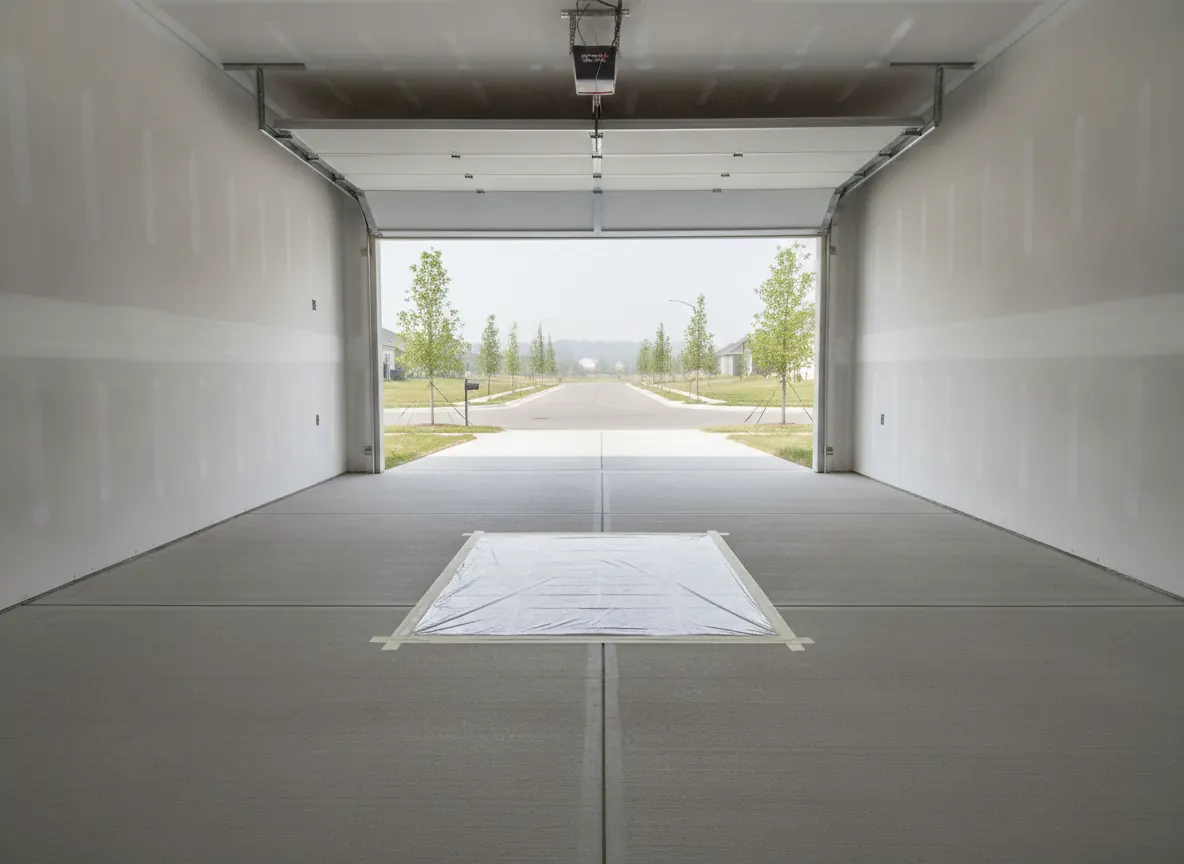
That same digest describes an easy check. Tape a sheet of polyethylene to the floor and leave it. If there are no damp spots under it after 24 hours, the flooring can be applied. It is an old method, and an installer may use a different test, but it shows what everyone is looking for: water still moving up through the slab.
Our climate affects the timing. The Evansville area’s muggy season runs roughly May 10 to October 13, July averages 29.3 muggy days, and late July 2025 brought dewpoints in the mid-70s to low 80s. Winter brings the opposite problem. The January mean low is 25.5°F, the average first freeze comes around October 26 and the last around April 7, so a cold-season job may need a heated garage or a cold-tolerant product. If a slab still tests damp, ask about a moisture barrier, which typically adds about $1 per sq ft.
Does a new garage floor still need grinding before epoxy?
Yes. New concrete has a smooth, dense top layer, and coatings bond poorly to it. Diamond grinding opens the surface so the base coat has something to grip, the same step used on a 1960s floor in Evansville. If you have already moved in, ask about dust. For walk-behind floor grinders, OSHA’s construction silica standard says contractors must use water delivery or a manufacturer-recommended dust collector, plus a HEPA-filtered vacuum between passes indoors.
Our concrete floor prep and crack repair page explains the grinding step, and do you have to grind a garage floor before epoxy? covers why acid etching is not a substitute.
What coating a new garage floor costs in the Evansville area
A new slab usually needs less patching than an older floor, but it still needs grinding and a moisture check. Typical installed ranges for 2025–2026 for a two-car garage of about 500 sq ft are estimates:
- Solid-color epoxy: $2,500–$4,000
- Flake epoxy system: $2,750–$5,000
- Polyaspartic flake system: $3,000–$6,000
The real number comes from an on-site look. See the full table on our garage floor epoxy cost guide. Before you sign, ask to see the written warranty. The FTC says a written warranty must spell out its coverage in one clear document, so read it for anything about slab moisture or how soon after the pour the coating went on.
Plan the coating after the concrete is ready
A new garage floor is a good candidate for a coating, as long as the slab has cured, tested dry and been ground first. When you request a free quote, mention when the concrete was poured and whether the house is in a new subdivision. That lets the independent local companies we connect you with plan the timing and the moisture check before they come out.
Quick answers
How long should new concrete cure before epoxy?
There is no single number for every slab. You will often hear 28 days, which is a common policy figure, but coating datasheets vary and research on bridge decks found some epoxy products can go on during the dry curing period. Follow the coating maker’s directions and have the slab checked for moisture before it is coated.
Can I coat my new garage floor before the first winter?
Often, if the slab has cured and tests dry. Evansville’s average first freeze is around October 26, and the January mean low is 25.5°F, so a fall or winter job may need a heated garage or a cold-tolerant product. Tell the installer when the concrete was poured so they can plan the timing.
Does a brand-new slab need grinding before epoxy?
Yes. New concrete has a smooth, dense top layer that coatings bond to poorly. Diamond grinding opens the surface so the base coat can grip, the same as on an older floor. A new slab usually needs less crack repair, but it should not skip the grinding or the moisture check.