
Can Garage Floor Epoxy Be Used Outside in Evansville?
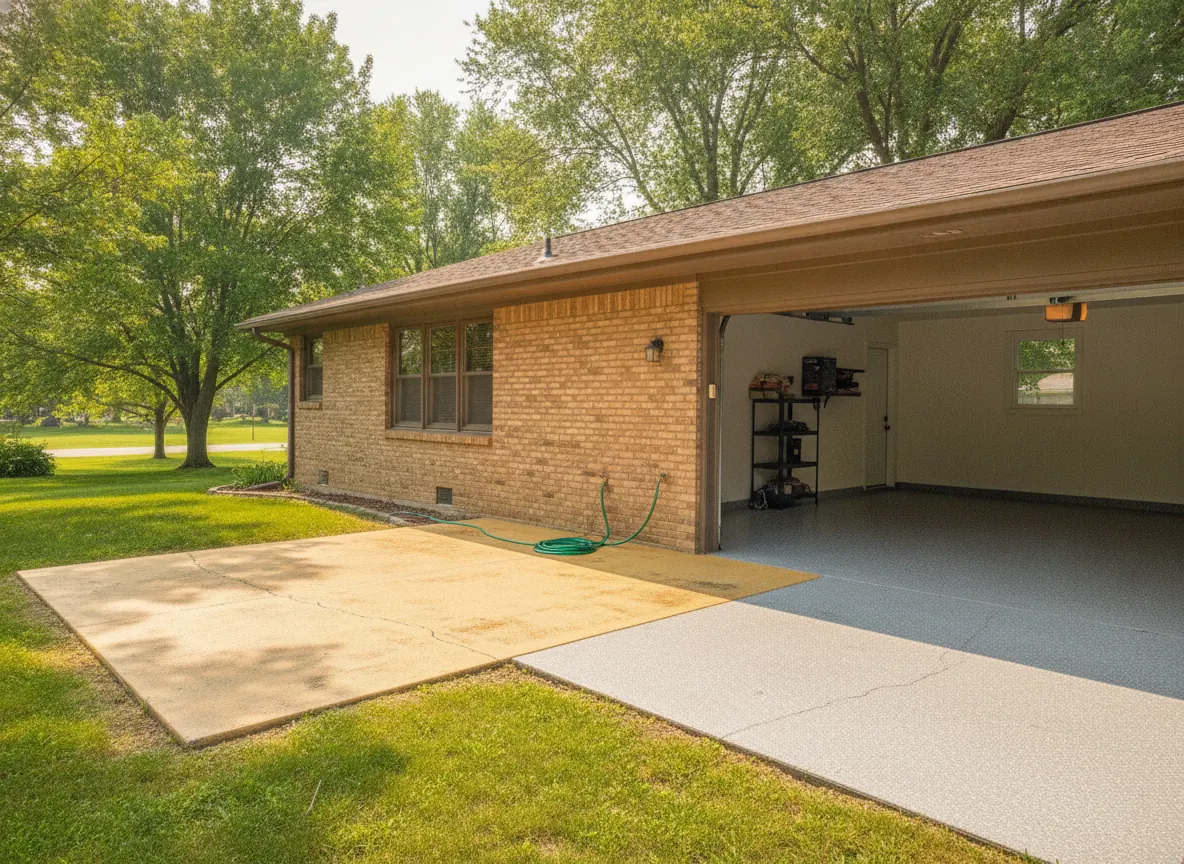
Can garage floor epoxy be used outside? It can go down outside, but plain epoxy is a weak choice for a patio, porch, walkway or driveway apron that sits in the sun. Sunlight breaks epoxy down: in a 2026 lab study, UV aging cut the bond between an epoxy coating and a cement-based surface by 15.7% in 28 days. Add the Evansville area’s rain, summer heat, freeze-thaw cycles and road salt, and an outdoor slab is a much harder job than a garage floor under a roof. Here is what that means for your concrete.
What sunlight does to an epoxy coating outdoors
The study, published in the journal Polymers in September 2026 and indexed by the National Institutes of Health, aged an epoxy coating on a cementitious substrate under lab UV light. After 28 days, adhesion strength had dropped by 15.7%. That is lab aging, not years of field data, but it points one way: UV weakens the bond that keeps a coating stuck to concrete.
The same paper cites earlier work in which UV exposure caused surface yellowing, mass loss and microcracking in an epoxy coating. Yellowing is a looks problem. Cracking and a weaker bond are the start of peeling. A garage floor under a roof is shielded from most of this. A south-facing patio is not.
Southern Indiana weather on an outdoor coating
Sun is only part of it. National Weather Service normals for the area put Evansville’s July mean high at 88.6°F, with about 41 days a year at or above 90°F. A normal year brings 47.91 inches of precipitation and 10.8 inches of snow. INDOT notes that Indiana pavements see “a large number of freezing and thawing cycles each year,” and the January mean low here is 25.5°F.
Then there is salt. The Vanderburgh County Highway Department typically spreads 7,000–11,000 tons a winter, and the city used 6,000 tons on 12 routes for the January 2026 storm. Across the river, Henderson County’s road department has used more than 2,000 tons in a single winter. Brine tracked onto a porch or splashed onto a driveway apron sits on whatever coating is there. Our post on road salt and garage floor coatings covers what salt does indoors; outside, the slab also gets rained on, baked and frozen on top of it.
The sunny strip of an indoor garage floor
This question matters for garages too. When the door is open on a summer afternoon, the first few feet of floor can sit in direct sun, depending on which way the garage faces. That same strip catches the most wet tires and salt slush in winter. If your garage gets a lot of sun, ask what top coat goes over the base and how it is meant to handle sunlight.
Many garage systems use more than one product, such as a base coat, flakes and a separate clear top coat. Our polyaspartic garage floor coating page and our epoxy vs polyaspartic comparison explain how the systems differ, so you can compare what each installer proposes.
Outdoor slabs are wet more often, so grip matters
A glossy finish that feels fine in a dry garage can be slick on a porch in a spring rain. Flake broadcast and anti-slip additives in the top coat add texture, and that matters more outdoors, where the surface is wet far more of the year. Our guide to whether epoxy floors are slippery goes through the traction options.
Read the warranty for sunlight exclusions
FTC guidance says a written warranty must lay out its coverage clearly in one document. The FTC’s own sample wording includes this line: “This warranty does not cover fading or discoloration caused by exposure to sunlight.” That is general consumer guidance, not a garage-coating rule, but it shows the kind of exclusion to look for. Ask for the written terms before you sign, and check whether outdoor slabs are covered at all.
Questions to ask before coating an outdoor slab
Some Tri-State coating companies list exterior concrete among their services, so it is worth asking rather than ruling it out. Good questions:
- Is this slab a good candidate, given how much sun and standing water it gets?
- Which product goes on top, and how is it meant to handle UV?
- How will you prep it? Outdoor concrete often carries dirt, old sealer and weathered surface that need grinding and crack repair first.
- What texture will you add for wet-weather grip?
- Does the written warranty cover outdoor use and sun fading?
Our concrete floor prep and crack repair page explains the prep steps. Outdoor prices vary too much to list here, so the real number comes from an on-site look.
The short answer for Evansville homeowners
Garage floor epoxy works best where it was designed to go: inside, out of the weather. Outside, sun, heat, rain, freeze-thaw and salt all work against it, and plain epoxy is the weakest choice for a slab in full sun. If you want a patio, porch or the sunny front of your garage coated, request a free quote and describe how much sun the area gets. The independent local companies we connect you with can tell you whether a coating makes sense and which system they would use.
Quick answers
Will epoxy on a patio turn yellow?
It can. Research cited in a 2026 study found that UV exposure caused surface yellowing, mass loss and microcracking in an epoxy coating. The same study measured a 15.7% drop in bond strength to a cement-based surface after 28 days of lab UV aging. A patio in full Evansville sun gets far more UV than a garage floor.
Is the floor near my garage door at risk from sun?
The strip nearest the door is the part most likely to get direct sun when the door is open, and it also catches the most wet tires and salt slush. If your garage gets a lot of sun, ask the installer what top coat goes over the base and how it is meant to handle sunlight.
Does a coating warranty cover outdoor use?
Read the written terms. FTC guidance says a written warranty must state its coverage clearly in one document, and the FTC’s own sample wording excludes fading or discoloration caused by sunlight. Ask whether outdoor slabs are covered at all before you sign, and keep a copy of the warranty.