
Are Epoxy Garage Floors Toxic? An Evansville Safety Guide
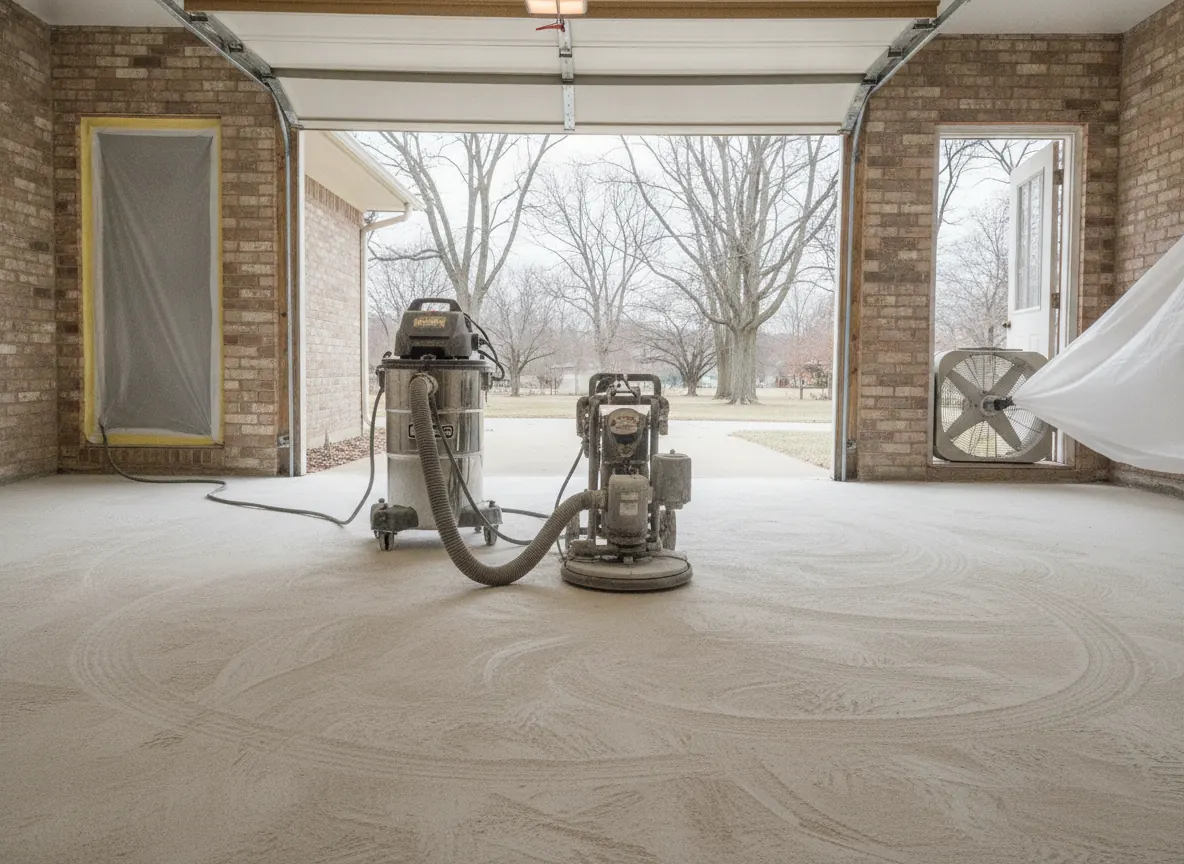
Are epoxy garage floors toxic? The safety questions sit mostly in the few days of installation, not the years after. Coating products give off fumes while they are mixed, rolled on and curing, and the diamond grinding that comes first throws off fine concrete dust. Good ventilation, following the product directions and an installer who controls dust handle most of it. Here is what each stage looks like in an Evansville-area garage, and what to ask before the work starts.
Epoxy floor fumes: when they matter
Fumes are strongest while the coating is being applied and while it cures. That is the window to plan around. Keep people and pets out of the garage, follow the safety directions printed on the product, and ask the installer two plain questions: how long should the space stay ventilated, and when is it fine to spend time in the garage again?
Many Tri-State homes have an attached garage with a door straight into the kitchen or laundry room. If yours does, ask how the installer plans to keep fumes out of the living space during the job, and keep that door closed until they say otherwise. Different systems cure at different speeds, so the answer for a multi-coat epoxy floor may not match a polyaspartic system. Our post on how long garage floor epoxy takes to dry covers the timeline side.
Winter installs in Evansville: ventilation in the cold
Ventilation is easy in May with the door rolled up. It is harder in January. National Weather Service normals for the area put the January mean low at 25.5°F, February at 28.4°F and December at 29.5°F. The average first freeze arrives around October 26 and the last around April 7, so for close to half the year the garage door stays down more than it stays up.
Coatings need the slab and air inside the product’s temperature range to cure properly, so installers working in cold months may heat the garage or choose cold-tolerant products. That creates a tradeoff between keeping heat in and getting fresh air through. If you are booking a winter job, ask how they will handle both, and expect the space to be off-limits a bit longer than it would be in summer.
Grinding dust: the safety question few homeowners ask
Most of the attention goes to fumes, but the prep step makes the most mess. Diamond grinding takes the top layer off the concrete, and concrete dust contains crystalline silica, which OSHA regulates under its own construction standard, 29 CFR 1926.1153.
For walk-behind floor grinders, that standard’s Table 1 says the machine must use either an integrated water delivery system or a dust collection system recommended by the manufacturer. When the work is indoors or in an enclosed area, a HEPA-filtered vacuum is used to remove loose dust between passes. The rule applies to employers and contractors, not to homeowners, but it gives you a clear yardstick for comparing installers.
This matters more on older slabs. Evansville’s median home was built in 1961, according to Census data, so many garage floors carry old paint, sealers, oil and patched cracks that take more grinding to get through. More grinding means more dust to control. Questions worth asking:
- What dust collection is connected to the grinder, and what about the hand grinder used at the edges?
- Do you use a HEPA-filtered vacuum between passes and at cleanup?
- What should I move out of the garage, and what should I cover?
- How will you seal off the door into the house?
You can read more about why grinding is done at all in do you have to grind a garage floor before epoxy? and on our concrete floor prep and crack repair page.
Does an epoxy coating keep radon out?
This one comes up with basement floors, and the honest answer is no, not by itself. An Indiana county health department page on in.gov notes that the EPA recommends against sealing alone to reduce radon. The same page lists cracks in floors and walls as a common way radon gets in, and uses 4 pCi/L as the level at which to mitigate.
So filling cracks and coating a slab is about a clean, durable floor, not radon control. If you are thinking about a basement floor coating, test the home for radon first. If the result is at or above 4 pCi/L, treat mitigation as its own job and plan the coating around it.
DIY epoxy kit safety vs hiring an installer
DIY kits typically cost $50–$600 for materials, and many rely on acid etching instead of grinding. Etching avoids most of the dust, but it means handling chemicals, so ventilation, protective gear and the product’s directions all matter. There is also a lifespan angle: water-based DIY epoxy typically lasts about 3–5 years, while a professionally installed solid epoxy commonly lasts 10–20 years. A shorter-lived floor means repeating the prep, the dust and the fumes sooner. Our comparison of DIY epoxy kits vs professional installation goes through the rest.
The bottom line on garage floor epoxy safety
Epoxy garage floor safety comes down to the installation days. Ventilate during application and curing, keep the house door shut, make sure the grinder has real dust control, and don’t treat a coating as radon mitigation. When you request a free quote, mention whether your garage is attached, whether it has an old coating and whether you want the work done in winter. That lets the independent local companies we connect you with plan ventilation and dust control before they arrive. You can also see typical installed ranges on our garage floor epoxy cost guide.
Quick answers
Is a cured epoxy garage floor safe to use?
The fume concerns are mostly about installation and curing. Once the coating has cured according to the product’s directions, you go back to using the garage normally. Ask your installer exactly when it is fine to spend time in the space again, park on it and move stored items back in, and follow the maker’s guidance rather than a rule of thumb.
Does OSHA’s silica rule apply if I grind my own garage floor?
No. OSHA’s construction silica standard covers employers and contractors, not homeowners working on their own house. Its controls are still a sensible model for anyone grinding concrete: a grinder with water delivery or a manufacturer-recommended dust collector, and a HEPA-filtered vacuum to pick up loose dust between passes indoors.
Will an epoxy coating lower radon in my basement or garage?
Don’t count on it. Indiana health guidance notes that the EPA recommends against sealing alone to reduce radon, even though floor cracks are a common entry route. Test the home first; if results are at or above 4 pCi/L, plan radon mitigation as its own job, separate from the floor coating.